

IBA, as the premier business brokerage firm in the Pacific Northwest, is firmly established as a respected professional service firm in the legal, accounting, banking, mergers & acquisitions, real estate, and financial planning communities. Periodically, we will post guest blogs from professionals with knowledge to share for the good of owners of privately held companies & family businesses. The following blog article has been provided by Heather Endresen of Viso Business Capital (https://visocap.net/):
The Silver Tsunami. The 85% Problem. The Data Explains Why.
Last week, Forbes published a Daily Cover story on the young buyers acquiring blue collar businesses to AI-proof their careers. The statistics in that story came from data we obtained from the SBA through a Freedom of Information Act request. Since we are the ones sitting on the full dataset, we owe you the longer version.
The two numbers we watch every quarter
Every quarter, when the SBA updates its loan data, we pull it and study one trend above everything else: how many SBA business acquisition loans are actually closing.
Then we hold that number against a second one: the total count of businesses listed for sale, which I track through the listing aggregator Kumo. One number tells you what brokers are bringing to market. The other tells you how many SBA business acquisition loans were funded (the only solid verifiable data we have on closings).
The gap between them is the real story of this market.
Only about 11 percent of listings can be verified as closing with an SBA business acquisition loan. We estimate another 4 percent or so close outside the SBA program, through cash, seller notes, or conventional credit. Call it 15 percent of listings that actually sell.
11% of listings verified closed with an SBA acquisition loan
~15% total listings that sell, including non-SBA closings
85% of listings that never sell at all
For perspective, roughly 90 percent of homes listed for sale eventually sell. Businesses run the opposite ratio. If houses sold the way small businesses do, most for-sale signs would stay in the yard until the owner gave up and took them down.
Why 85 percent of listings go nowhere
It is not a lack of buyers. Demand for good businesses is the strongest we have seen in 30 years of SBA lending. The problem is what shows up for sale.
Most failed listings trace back to one root cause: unrealistic valuation expectations. It shows up in two flavors.
The first is simple. The seller wants a price to earnings multiple that is well above market. The price is wrong on day one, and if the seller is strongly anchored to that valuation, no amount of market feedback fixes it.
The second is sneakier. The seller applies a perfectly normal multiple, but the earnings are inflated by either bad bookkeeping or expense add-backs that cannot be justified. The listing looks reasonable. A buyer engages, orders a quality of earnings review, and the earnings shrink under inspection. The price that made sense in the teaser no longer makes sense in diligence, and the deal dies.
Why the silver tsunami keeps not arriving
People have been predicting a silver tsunami of retiring boomer sellers for more than a decade. Our data shows 2025 was a record year, with 6,915 SBA acquisition loans closed for $8.17 billion. A record, yes. A tsunami, no.
My view is that the tsunami will not happen, or will not really happen, until the sell side changes. Sellers and their brokers keep bringing the 85 percent to market anyway. As long as that continues, the number of closings is capped by the supply of genuinely salable businesses, not by buyer appetite.
Why brokers keep taking listings that will not sell
If 85 percent of listings never sell, why do brokers keep taking them? Here is the uncomfortable answer: right now, an unsalable listing is not a cost to the broker. It is inventory.
A business listing costs almost nothing to take. And even when it never closes, it produces something valuable: buyer leads. An overpriced listing still generates inquiries, still collects signed NDAs, and still builds a list of active, motivated buyers the broker can market other listings to. Some firms collect upfront valuation or packaging fees on top. The listing that never sells can still pay for itself on the way in.
The seller feels no pressure either. A house that sits unsold bleeds mortgage payments and property taxes every month. A business that sits unsold just keeps operating and paying its owner a salary. There is no carrying cost pushing the seller toward a realistic price.
So the 85 percent persists because nobody inside the system is losing money on it. Brokers harvest leads. Sellers keep their paycheck. The only people paying are buyers, in wasted weeks of diligence. That is the arrangement AI is about to break.
What we think will finally force the change: AI on the buy side
Buyers are getting smarter, and they are getting smarter much faster than sellers are. Many Quality of Earnings and other specialty diligence vendors have popped up to serve the space in the last 6 or 7 years by finding ways to provide these services efficiently and at reasonable prices that fit these smaller deals. And now, a wave of AI platforms helps buyers triage teasers, screen financials, and run initial underwriting in a fraction of the time it used to take. The work that once took a buyer three weeks of spreadsheet archaeology now takes an afternoon.
That changes the physics of the market. Buyers will spot the 85 percent and discard it in minutes. Unprepared listings will sit untouched, and brokers will feel it in their conversion rates. More buyer discipline means fewer deals will close on a good story. At some point, taking a messy listing to market stops being worth the broker’s time.
Where we stand on that timeline
The screening technology already exists at the top of the market. Private equity firms now run every incoming deal book through AI that extracts the financials, flags unjustified add-backs, and scores the opportunity against their criteria in minutes. But notice where that screening happens: after the NDA. The weak listing still collected the buyer’s signature and contact information on its way to dying. The lead-gen machine still runs.
The missing piece is pre-NDA screening: a way for buyers to skip the bad listings without ever requesting the full package. That piece arrives when the listing platforms and aggregators build deal scoring directly into the browsing experience. Once every listing carries a machine-read signal of closability, every buyer gets triage by default, with no tool to buy and no new habit to build. We expect to see that within the next 18 to 24 months.
When it happens, the lead-gen economics flip. Today, a thin teaser protects a weak listing, because the only way to learn more is to sign the NDA, and curiosity gets those NDAs signed. Once buyers can triage 50 teasers in an afternoon, the default reverses: discard unless the teaser proves it. Vague stops being intriguing and starts being disqualifying. The unsalable listing stops producing even leads, and at that point taking it to market truly stops being worth the broker’s time.
Here is how we see the next three to five years unfolding:
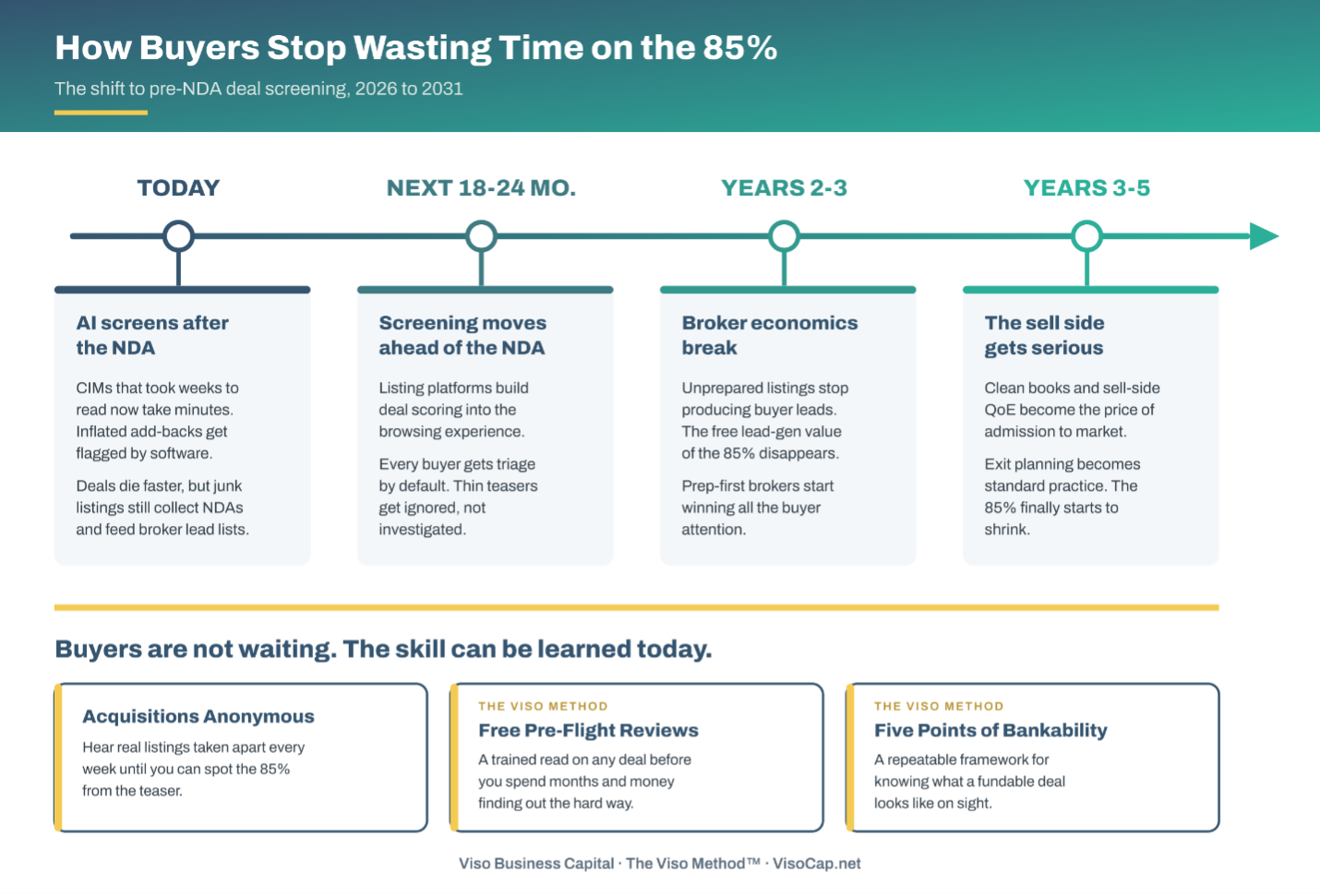
The shift to pre-NDA deal screening, 2026 to 2031. © Viso Business Capital.
That last phase is when exit planning finally becomes standard practice. Sellers will start accessing the same information buyers have used for years to judge what makes a business salable. The prepared seller who truly wants to accomplish a transfer of ownership and retire with some financial reward for their work will do three things before ever going to market:
- Clean up the accounting, ideally two to three years before a sale, so the earnings on paper match the earnings in reality
- Commission a sell-side quality of earnings review first, so the number a buyer diligences is the number that was advertised
- Learn what real multiples look like from the comp and listing data buyers already study, and price accordingly
None of this is complicated. It is the business equivalent of fixing the roof and staging the house before the open house. Sellers who do it will find a deep pool of motivated, well-financed buyers waiting. Sellers who do not will keep feeding the 85 percent.
What this means if you are buying
Until the sell side catches up, the skill that matters most for a buyer is recognizing the 85 percent on sight and moving on quickly. Every week spent in diligence on an unsalable business is a week not spent finding a fundable one. That discipline, knowing what a bankable deal looks like before you fall in love with a listing, is the core of The Viso Method, and it is exactly the conversation we have with buyers every day.
And you do not have to wait for the platforms to catch up. Viso is already part of this shift. Every free Pre-Flight Review is a trained set of eyes telling a buyer whether a deal belongs in the 15 percent before serious money and months get spent, and the Five Points of Bankability exist so buyers can run that test themselves.
There is an even lower-tech way to build the skill: listen to deal people take deals apart. On Acquisitions Anonymous, the podcast I co-host, we break down real listings every week. Regular listeners tell us the same thing: after enough episodes, they can spot an unjustified add-back from the teaser. That is the buy side of this market getting smarter in real time, no software required.
Heather Endresen spent 30+ years in banking before founding Viso Business Capital to give business buyers an edge most learn too late. Through the Viso Method and a network of 30+ SBA acquisition banks, Viso guides entrepreneurs from a fundable deal structure to a closed loan, matching each deal to the right banks for faster, more competitive term sheets at no cost to the buyer (Viso is paid by the lender at closing). In under three years, Viso has funded over $400 million in SBA acquisition loans. Heather also co-hosts the popular acquisition podcast Acquisitions Anonymous. Ms. Endresen can be reached with questions about this article or the funding process associated with buying a business at (714) 404-3648 and [email protected].
IBA, the Pacific Northwest’s premier business brokerage firm since 1975, is available as an information resource to the media, business brokerage, mergers & acquisitions, and real estate communities on subjects relevant to the purchase & sale of privately held companies and family businesses. IBA is recognized as one of the best business brokerage firms in the nation based on its long track record of successfully negotiating “win-win” business sale transactions in environments of full disclosure employing “best practices”.